
For a long time, a wrong tax number on an invoice was just an accounting problem. Someone in finance would spot it during month-end reconciliation, fire off a correction email, and move on. The invoice had already been issued, and the cash was either already in motion or at least in the pipeline. Managing bad data was a clean-up job and rarely a roadblock. That entire assumption is about to be changed as UAE e-invoicing becomes a reality. Achieving full UAE e-invoicing compliance is now a critical priority for finance teams.
Under the Ministry of Finance’s phased UAE e-invoicing rollout for UAE e-invoicing compliance, large businesses with revenue above AED 50 million must appoint an accredited service provider and be live by 1st January 2027, with the appointment window recently pushed to 30th October 2026. Smaller businesses and government entities follow through the rest of 2027.
However, the dates matter less than the mechanics behind them. This is not another regulation that can be complied with by bolting an upgrade to your existing invoicing process. It is a new gatekeeper that demands much more!
What is UAE e-invoicing and how does it work?
What are Continuous Transaction Controls (CTCs) in e-invoicing?
The UAE has adopted what’s known as the Decentralised Continuous Transaction Control and Exchange model, or the five-corner approach. Your business, accredited service provider (ASP), your customer, its ASP and the Federal Tax Authority will all become connected in a single invoice validation chain.
What is PINT-AE in UAE e-invoicing?
Before an invoice can legally reach your customer, it must first pass structured checks against the national data dictionary and a standard called PINT-AE that covers roughly 50 mandatory fields. During this invoice validation process, only machine-readable XML, JSON or UBL formats are accepted under PINT-AE. Therefore, PDFs, scans & even beautifully formatted Word invoices, are no longer accepted as legal tax documents.
What most CFOs and finance leaders miss here regarding master data management is that strict invoice validation happens before issuance, not after. For instance, if a customer’s Tax Registration Number is missing, misformatted, or belongs to a legal entity name that doesn’t match what’s on file, the invoice is not merely delayed — it fails the invoice validation and never gets created!
This means no billing event, no VAT trigger, and no start to your collection clock. In a business running on 30, 60 or 90-day payment terms, that’s a working capital problem with a very literal start date.
Common master data issues in UAE e-invoicing compliance: Lessons from Neighbouring Markets
The UAE isn’t the first Gulf economy to walk this path, and the evidence from Saudi Arabia’s ZATCA rollout gives many learning opportunities. Across multiple compliance waves in the region, focusing on master data management has proven essential. The single most evident cause of invoice rejection has been a missing or incorrect buyer Tax Identification Number (TIN). It has been described by tax advisors as the error that can stall a transaction entirely.
In fact, this report indicates that errors linking credit and debit notes to the wrong invoice reference have been responsible for at least 70% of rejections in some provider datasets. None of these is exotic technical failures, but simple gaps in master data — the kind every finance team assumes are mostly fine until a regulator’s validation engine starts blocking them.
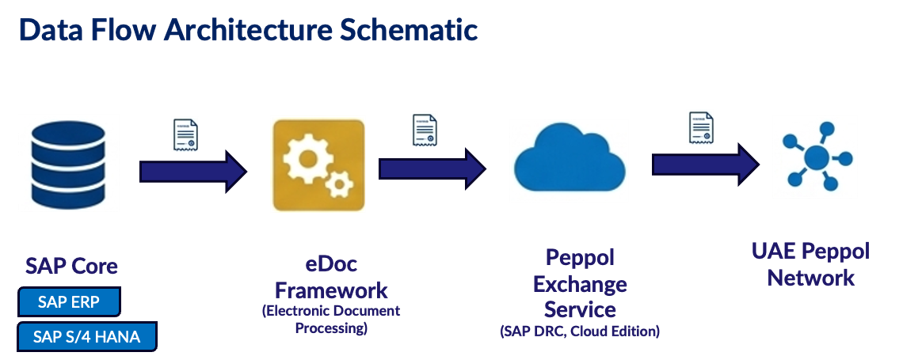
SAP, now pre-approved as a service provider under the UAE framework, flags this candidly in its own guidance to customers. Pre-approval, however, should not be mistaken for plug-and-play readiness — activating SAP’s Document and Reporting Compliance (SAP DRC) capability still requires its own separate license and a dedicated implementation effort to achieve true ERP readiness. The most common reason SAP DRC projects stall is integration failure. It’s about discovering late that the customer and vendor master records contain thousands of invalid TRNs, inconsistent legal names, or special characters that a compliant schema simply cannot parse. Put differently, while the SAP DRC technology to comply already exists and works well, what breaks projects is the data feeding it.
How to ensure full UAE e-invoicing compliance?
Why is master data management critical for ERP success?
Here’s what we have seen during customer engagements. Most finance leaders don’t actually know what bad data is costing them, highlighting a massive gap in master data management. This is because most organisations have never measured it. Gartner puts this number at a staggering USD 12.9 million on average per organisation! However, Gartner also revealed that nearly 60% of the organisations don’t measure this cost at all.
That combination, a large, real financial exposure sitting alongside almost total invisibility, is exactly the kind of risk that boards dislike most. It’s unquantified, unowned, and easy to defer until it becomes urgent. For businesses in the UAE that are facing a real-time UAE e-invoicing mandate, this ‘urgent’ can arrive the day your first batch of invoices to a long-standing customer bounce back unissued.
Therefore, for finance leaders, at that point, this no longer remains a data problem, leaving them explaining a cash-flow gap to a board that assumed their ERP and other finance systems were working ‘just fine’.
How to assess ERP readiness before implementation?
Most transformation programmes start with the technology: They kick off by picking an ASP, scoping the integration, building the XML mapping and testing the connection. While that sequencing is not wrong, it’s incomplete if it isn’t preceded by an honest, quantified look at what’s actually sitting in your customer and vendor master records at the moment to ensure ERP readiness.
If you are wondering how to prepare your ERP for UAE e-invoicing, this is where we have found the most value working with finance and tax teams across the region. The secret is not to go straight for a system overhaul but start with a focused, sampled diagnostic of existing vendor and customer master data. This includes checking TRN validity, legal name consistency, address formatting, and the specific fields that PINT-AE validation will scrutinise.
At Percipere, we run this as a deep-dive Health & Readiness Check — going beyond master data alone to also assess process and system readiness, giving the CFOs a quantified look at the current state of their data, systems and processes for complete ERP readiness. Rather than saying ‘your data might have issues,’ it’s an evidence-based picture of exposure — how many records would fail validation today, what process and system gaps sit alongside that risk, and what that implies for invoice-blocking risk — before a single dollar is spent on system configuration.
The mandate you’re preparing for is not the last one
The case for treating master data management as infrastructure and not a one-time clean-up exercise is that UAE e-invoicing is only the first step in the broader scheme of digital transformation that the region is moving towards. Corporate tax reporting, economic substance obligations, and customs digitisation are all converging on the same underlying requirement — that your ERP holds structured, validated, machine-trustworthy data about every counterparty you deal with.
Here, the businesses that treat their current master data management clean-up as a one-off UAE e-invoicing project will likely find themselves repeating the exercise for the next mandate, and the one after that.
The businesses that instead build a standing data governance discipline, defining clear ownership of who corrects a TRN, how a new customer record gets validated at creation, how legal entity names stay synchronised across CRM, ERP and billing systems, will find each subsequent regulatory shift progressively cheaper to absorb on their journey of UAE e-invoicing compliance. In a region moving this fast on tax digitisation, that discipline in UAE e-invoicing is a genuine operating advantage.
The question worth asking in your next finance leadership meeting is not only which ASP should we choose, but if we validated our top 500 customer records against PINT-AE rules today, how many would fail — and what would that cost us on day one of UAE e-invoicing?
Most CFOs don’t yet have that number. The ones who get it first will be the ones least surprised come 2027 when the UAE e-invoicing mandate goes live.
FAQ’s
What is UAE e-invoicing and how does it work?
UAE e-invoicing is a government-led digital invoicing framework that requires businesses to exchange structured electronic invoices through Accredited Service Providers (ASPs). Unlike traditional invoicing, invoice data is validated before it reaches the customer, helping improve tax compliance, reduce fraud, and support real-time regulatory reporting.
What are Continuous Transaction Controls (CTCs) in e-invoicing?
Continuous Transaction Controls (CTCs) are government-mandated validation mechanisms that verify invoice data before or during its exchange. The UAE has adopted a decentralised CTC model, where Accredited Service Providers validate invoice information before invoices are exchanged between trading partners and reported to the relevant authorities.
What is PINT-AE in UAE e-invoicing?
PINT-AE is the UAE’s standardised electronic invoice specification that defines the mandatory data fields, business rules, and technical structure required for compliant e-invoices. Businesses must ensure their ERP systems generate invoices in the required structured format to successfully pass validation checks.
How to ensure full UAE e-invoicing compliance?
Achieving UAE e-invoicing compliance requires more than implementing new technology. Organisations should assess ERP readiness, improve master data quality, configure compliant invoicing processes, integrate with an Accredited Service Provider (ASP), and establish governance controls to ensure invoice data consistently meets regulatory requirements.
Why is master data management critical for ERP success?
Master data management ensures customer, vendor, and financial records remain accurate, consistent, and complete across business systems. High-quality master data supports successful ERP implementations, accurate tax reporting, and compliant e-invoicing, while reducing invoice rejections, payment delays, and operational risks.
How to assess ERP readiness before implementation?
An ERP readiness assessment evaluates your systems, business processes, data quality, integrations, governance, and regulatory requirements before implementation begins. Identifying and resolving gaps early helps reduce project risk, minimise costly rework, and ensure your organisation is prepared for UAE e-invoicing.
How to clean ERP master data before e-invoicing rollout?
Start by auditing customer and vendor master records for missing or invalid Tax Registration Numbers (TRNs), inconsistent legal entity names, duplicate records, and incomplete address details. Standardise data formats, validate records against regulatory requirements such as PINT-AE, and establish governance processes to maintain data quality before implementing UAE e-invoicing.
How to validate a UAE Tax Registration Number (TRN)?
Businesses should verify that every customer and supplier Tax Registration Number (TRN) is accurate, active, and correctly linked to the corresponding legal entity. Validating TRNs during customer onboarding and conducting regular reviews helps reduce invoice validation failures and supports ongoing UAE e-invoicing compliance.
How to enable SAP e-invoicing for UAE VAT compliance?
Organisations using SAP can support UAE e-invoicing through SAP Document and Reporting Compliance (SAP DRC). A successful implementation involves configuring regulatory reporting, integrating with an Accredited Service Provider (ASP), mapping invoice data to PINT-AE requirements, and validating master data before go-live.
What is SAP DRC and how does it work?
SAP Document and Reporting Compliance (SAP DRC) is SAP’s solution for managing electronic invoicing and statutory reporting. It enables organisations to generate compliant invoice formats, connect with Accredited Service Providers and tax authorities, validate transactions, and support evolving e-invoicing regulations across multiple countries.