
The Region Is Changing Its Stand on Invoicing
For most of the modern Gulf’s commercial history, the invoice sat outside the state’s reach. Under classical Islamic commercial practice, a transaction’s validity rested on fairness between the two parties, not on a tax authority watching it happen in real time. Even after VAT arrived in the UAE and Saudi Arabia in 2018, filing stayed a periodic, after-the-fact exercise, and an invoice remained a private document until an auditor asked to see it. Every finance function in this region, and every SAP landscape built to support it, was designed around that assumption.
That assumption no longer holds. The change is not on the horizon, and it is not a rumour out of a tax conference. It is already running, in three capitals, at the same time, and it is rewriting the exact moment a transaction becomes real
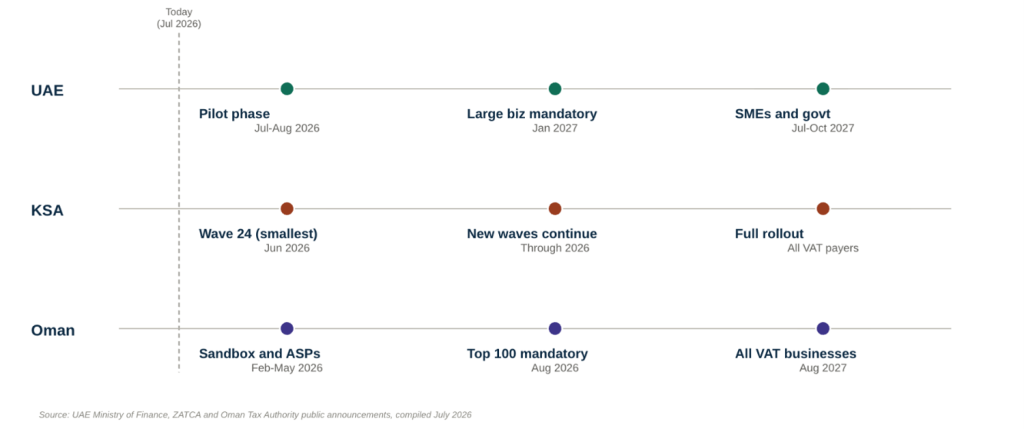
The UAE’s Ministry of Finance has adopted a Decentralised Continuous Transaction Control and Exchange (DCTCE) model built on the Peppol five-corner network, using the PINT AE data standard. This is not a future-state roadmap item to schedule for next year: the voluntary phase is live today, the country’s top 100 taxpayers move into a mandatory pilot as early as next month, and the full mandatory go-live for large businesses lands on 1 January 2027 — closer than most SAP re-implementation projects take to plan from kickoff to cutover.
Businesses with revenue above AED 50 million face the sharper deadline. They now have until 30 October 2026 to appoint an Accredited Service Provider, a private company licensed by the Ministry of Finance to validate, transmit, and report invoice data on their behalf. Miss that date, and there is no compliant invoice to send — which means a stalled deal, a stalled payment, a stalled month-end.
Saudi Arabia is not a preview of what’s coming to the UAE. It is proof of where this ultimately goes. ZATCA’s Fatoora programme has already pushed through more than twenty rollout waves, pulling progressively smaller businesses into its net with each one. If your business operates in the KSA, here is a more detailed guide on e-invoicing worth reading closely.
Notably, unlike the UAE’s decentralised model, Saudi runs a clearance system: an invoice is not legally valid until ZATCA approves it. This happens typically in real-time in B2B and B2G scenarios and generally takes 24 hours maximum in B2C cases. No approval, no revenue recognition, no collection — the authority now sits between you and your own cash.
Oman is next, and it is closing the gap on its own terms. Its Fawtara programme is expected to open a mandatory pilot for roughly 100 large VAT-registered companies from August 2026, running its own Peppol five-corner model, ahead of a full market rollout within a year.
Three governments. Three timelines. Three technical models. One message sits underneath all of it, and it should concern every leadership team reading this: this is not a mandate you clear once and file away. It is a moving regulatory perimeter that keeps tightening on a published schedule, and it now sits inside your transaction flow whether your finance organisation is ready for it or not.
Why This Concerns Your Leadership Team and Not Just IT?
It is still tempting for leadership to hand this to the ERP team and consider the matter closed. That instinct is now a liability. Under a clearance or continuous-control model, an invoice that fails validation is not a paperwork problem — it is blocked revenue, immediately. A data mapping error, a mishandled credit note, or a single Peppol routing failure inside your service provider’s stack can stall collections, provoke customer disputes, and land squarely on a finance team with no slack left to absorb it. Boards are already asking the C-suite whether the business is ready, and the honest answer needs to go beyond: our vendor says we are covered.
There is a cost to treating this as pure box-ticking that goes beyond the scramble, too. Companies that stop at compliance risk missing what sits inside the same requirement: structured, real-time invoice data is a genuine foundation for faster reconciliation, sharper working-capital visibility, and cleaner audits — but only if the partner behind it is built to deliver that, and not simply to pass certification.
Therefore, choosing the right partner pays for itself well beyond the deadline, with compliance becoming the by-product of a genuinely better finance operation for your business.
How To Find a Partner That Is Right for Your Business
If you can strip away the bells and whistles, it all boils down to a handful of criteria that separate a dependable e-invoicing partner from a liability in waiting. Here is a short checklist of what your e-invoicing partner must bring to the table:
- Verified accreditation: Confirm any provider against the official Ministry of Finance list of pre-approved service providers in the UAE, or ZATCA’s published integrators in Saudi Arabia. As of July 2026, 42 providers had cleared accreditation, with more in progress.
- Genuine Peppol network maturity:Because the UAE and Oman both run five-corner Peppol models, your provider’s access point needs a proven track record of exchanging invoices reliably across networks, not just a certification on paper.
- Native ERP integration: A browser portal bolted onto your finance stack creates a second system of record, making reconciliation complex. A more practical approach is a provider who builds directly into your existing SAP or ERP environment, so that invoice generation, validation, and archiving happen inside the system your finance team already uses.
- Multi-country coverage: Most sizeable Gulf enterprises transact across the UAE, Saudi Arabia, and increasingly Oman. A partner who understands the landscape in all three regimes, and their different clearance processes versus decentralised models, can save you a lot of time and reworks in the long run.
- Data residency and security discipline:Invoice data now sits under tax authority scrutiny. Therefore, your archive needs to meet local retention and integrity rules, not just generic cloud-security assurances.
- Support that understands your calendar and priorities:Month-end close, VAT filing deadlines, and Ramadan working patterns are regional realities. A support desk in a different time zone, working off a different fiscal calendar, will cost you exactly when you can least afford it.
How To Know If You Are Being Sold a Workaround Rather Than a Solution?
Chek if your is generic by design, retrofitted into the region without deep familiarity with PINT AE, Fatoora’s clearance rules, or Fawtara’s emerging requirements. Be equally cautious of single-country point solutions that might solve the current UAE deadline but leave you starting from zero when Saudi or Oman obligations expand. And watch for opaque, per-invoice pricing models that might look inexpensive in a pilot and becomes a burden at scale!
A Practical Path Forward
As a forward-looking leader you should not wait for the enforcement date to become the testing date. Instead, use the time for dress rehearsal and prepare.
Map your invoice volumes and formats, shortlist providers against verified accreditation lists, run a live pilot with real transactions before it becomes mandatory, and build in enough runway to fix what breaks without the pressure of a hard cutover date. Businesses that treat readiness as a quarter-by-quarter programme, rather than a single deadline, are the ones who are more likely to go live without disruption.
This is also where specialised implementation experts can help in a smoother run. Consultancies like Percipere, possessing years of experience working for businesses in the region and focus specifically on SAP-based e-invoicing rollouts across the UAE and wider Middle East, exist precisely for this. Worth a look if your team is still evaluating how to get from where you are to where the mandate needs you to be!
Whichever partner you choose, your choice must be deliberate and informed. The invoice may still look like the least interesting document in your business. However, what moves through it now decides how well the rest of your finance function runs.